
Checking for a Warrant in Miami
Miami posts no public warrant roster, and the town offers no warrant lookup of its own. So start with the case itself. Dig out any citation number, court name, hearing date, or Miami Municipal Court label you can find. Arizona DPS runs a name-and-date-of-birth warrant search statewide, though DPS warns its data may be incomplete or delayed, so any hit still needs confirmation from the issuing court. Follow this order:
- Search the Arizona DPS warrant form as an initial lead.
- Check Arizona Public Access for a participating-court case.
- Call the Miami Municipal Court listing at (928) 425-3231 and say “Miami Municipal Court.”
- Use Miami Police at (928) 473-4403 only for police records or local law-enforcement routing.
- Ask the clerk what action recalls the warrant and when the docket will show it.
A recall means the Miami court withdrew the warrant; a quash means a judge canceled it outright. Neither follows from a traffic stop, a payment receipt, or a blank search result. Only the court's own records show the difference.
Miami Warrant Authority in Title 2
Miami's town code is unusually clear about where its warrant authority sits. Chapter 2.16 creates the Miami Municipal Court. That court handles town ordinances plus concurrent state-law matters inside town limits, meaning another court system may share authority where the law assigns it. The municipal judge also sets bonds and handles fines and fees tied to those cases.
- Municipal jurisdiction
- The types of city cases a town court may hear.
- Concurrent jurisdiction
- Authority shared with another court under state law.
- Bench warrant
- A judge's order often tied to a missed appearance or unmet court duty.
- Recall
- The issuing court's formal withdrawal of the warrant.
The official Miami Title 2 code offers no public warrant search, no bond schedule, and no recall form. What it does is name who holds the legal authority. For case-specific steps, ask the clerk rather than guessing from a general code section.
Miami Police and Municipal Court
Miami Police sits at 500 W. Sullivan Street, Miami, AZ 85539. The published non-emergency line is (928) 473-4403, staffed Monday through Friday, 8 a.m. to 5 p.m. Emergencies still go through 911. The department routes police-report and law-enforcement questions, but it publishes no live warrant interface.
Miami Police Department
(928) 473-4403
Use this channel for Miami police records and department routing, not a judicial ruling on current warrant status.
Miami Municipal Court
(928) 425-3231
The state directory uses this shared courthouse number. Name Miami Municipal Court, then verify the desk or extension.
The official Miami Police source leads into the successful manifest image below.
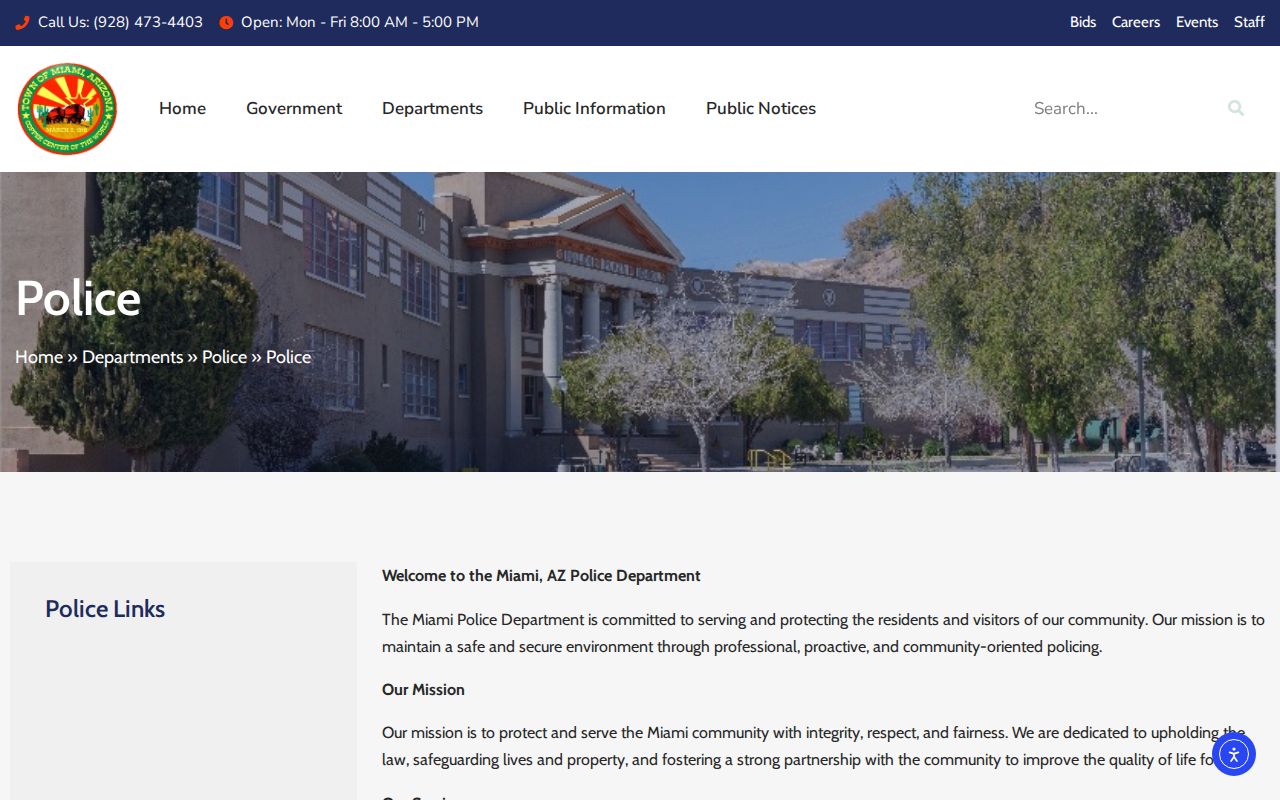
The contact page supports police routing. It does not replace court confirmation.
Miami Warrant Dispatch Handoff
A 2022 agreement between Miami and Gila County moves 24-hour telephone, 911, radio, and law-enforcement information support to county dispatch. Under that agreement, county dispatch receives and records Miami warrant information and keeps records coordinated between the two. It is an operational handoff, though, not a public search product.
| Function | Miami route | What it cannot do |
|---|---|---|
| Emergency response | 911 and county-supported dispatch | Provide a routine public warrant search |
| Police record | Miami Police | Recall a court warrant |
| Municipal case | Miami Municipal Court | Answer for every Superior case |
| Warrant service data | Law-enforcement coordination | Replace the issuing docket |
Ask which court owns the underlying file. Dispatch may hold the law-enforcement side while the Miami town court holds the official outcome of the case. Only the issuing judicial office can confirm whether a warrant has actually been withdrawn.
Miami Warrant Types
Warrant labels in Miami track the court and the event behind the record. A municipal warrant grows out of an ordinance or criminal matter in the town's jurisdiction. A bench warrant usually follows a missed hearing or a failure to comply. An arrest warrant takes a judge's probable-cause finding. Traffic cases can carry a warrant, an FTA entry, or a vehicle-registration hold, and those three are distinct things.
| Type | Source event | First Miami check |
|---|---|---|
| Municipal warrant | Town ordinance or city criminal file | Miami Municipal Court |
| Bench warrant | Missed date or court duty | Issuing clerk |
| Traffic warrant | Criminal-traffic failure to appear | Court on the citation |
| Arrest warrant | Probable-cause order | Court named by DPS or the record |
| Superior warrant | General-jurisdiction case | Gila Clerk of Superior Court |
Arizona courts sometimes say capias pro fine when enforcement is about unpaid money. Not every Miami bench warrant fits that label. Read the exact docket term and ask the court what it means.
Miami Warrant Search Number Trap
The state court directory lists (928) 425-3231 for Miami Municipal Court. Other Gila contacts, including the Globe courthouse, share that same line. One number serving several offices saves the county effort, but a caller who says only "I have a warrant question" may reach the wrong desk. Give the full court name, the town, the case number, and the type printed on your notice so the Miami warrant question lands with the right clerk.
Quick answer: For a Miami city case, say “Miami Municipal Court” when calling (928) 425-3231 and ask staff to verify the current desk or extension.
Miami Police answers a different line, (928) 473-4403. Officers can route law-enforcement matters, but that call cannot replace the court's own word on the case. If the clerk transfers you, write down which office took over. That habit keeps county dispatch, town police, and the Miami municipal docket from blurring into one database.
Inside a Miami Warrant Record
A solid warrant confirmation rests on more fields than a name. Names alone invite false matches. Pair the name with date-of-birth information, the court identity, and the case number before trusting any Miami warrant record. The sample MI-CR-01234 only shows how to repeat a file key back to a clerk; it stands for no real Miami case and implies nothing about local numbering.
| Case or warrant number | The clerk's file key. |
|---|---|
| Issuing court | The judicial office that controls status and recall. |
| Name and birth data | Identifiers used to test the match. |
| Charge or event | The ordinance, offense, missed date, or order involved. |
| Bond or amount | Any released term, subject to current confirmation. |
| Status | May say active, served, recalled, or quashed. |
Always ask when a Miami record was last updated, since state systems can lag. Keep the case number and the court's confirmation with any receipt or filed motion.
Miami Warrant Payment Is Separate
Miami's municipal code gives the judge duties over bonds, fines, and fees, yet the city publishes no general warrant bond schedule, recall fee, or online warrant-clearing form. So do not pick a payment channel just because a balance shows. Call the clerk first. Ask whether payment is even allowed on this Miami case, whether an appearance is still required, and which action actually recalls the warrant. If the court approves a payment route, keep the receipt and ask when it posts. A balance can be paid while another court event stays due. Police and dispatch cannot turn a transaction into a judicial order. An attorney can help when appearance risk or a motion is involved.
Note: A payment receipt proves a transaction, not a Miami warrant recall.
How Miami Warrants Fit the County System
Miami's own court issues municipal warrants. Miami Police and county-supported dispatch share law-enforcement information, and the Gila County Sheriff may serve a warrant or hold related agency records. Arizona DPS runs the statewide name-and-birth-date lookup, yet only the issuing court can recall what it signed.
Warrant flow: Miami Municipal Court / Miami Police › Gila County dispatch and Sheriff › Arizona Department of Public Safety Warrant Search
Think of this as a handoff, not a single database. The Gila County warrant records overview maps the county court, sheriff, and records-request routes. A Miami resident should name the city court and file first. Go countywide only when the issuing record or agency role requires it.
Miami Warrant Check Before Travel
Prepare before you visit or arrange an appearance. Confirm the issuing court, the desk, the hours. Ask whether an in-person event is required. Ask too whether bond is set, which payment types are accepted, whether counsel may file, and whether custody is possible. Miami publishes no walk-in surrender plan, parking or security rule, required-ID list, local warrant fee, or motion-to-recall form, so ask the clerk directly.
Do not guess: Use official town, court, county, or state numbers. Ask for current status and written or docket confirmation after the required act.
A clerk gives procedure, not legal advice. An attorney handles your legal options. Bring the citation or notice, case number, and identification only after asking what the Miami court accepts. After any hearing, payment, or filing, confirm the court entered a recall or other final status.
Miami Warrant Records and Public Access
Arizona Public Records Law backs inspection and copies during office hours, though it does not open every court item. Sealed, juvenile, mental-health, victim, witness, protection-order, and other restricted material can be withheld. Arizona Public Access covers participating courts and updates weekly. A blank result still cannot clear a Miami warrant.
Key rules:
A.R.S. § 39-121.01 addresses inspection and copies, with lawful limits. A.R.S. § 8-208 governs juvenile-record confidentiality.
GCSO Records is a fallback for Sheriff-held reports and adult arrest records. Its request process and 10 to 14 working-day guidance form no same-day Miami warrant hotline. Send each request to the office that maintains that record.
Miami Warrant Office Confirmation
The Town of Miami's official government source supports municipal identity and contact context.
Verify any office through the town source before sharing case details. That page is not a Miami active-warrant roster. Miami's 2020 Census population was 1,541, and town size says nothing about warrant volume or court activity. No Miami office publishes a current warrant count. End the check with the issuing clerk. Ask for the exact status, the controlling case event, safe appearance instructions, and the expected posting time. If DPS named a court, repeat it. When police or dispatch routed the question, confirm the destination is the judicial office, then keep written proof after the Miami case closes.