
Gila County Arrest Warrants Explained
Every arrest warrant in Gila County starts the same way: a sworn statement. Under A.R.S. § 13-3897, a magistrate reads the affidavit and decides whether probable cause supports the offense described. If it does, the signed order tells law enforcement to arrest the person named. The issuing authority could be Gila County Superior Court, a Regional Justice Court, or a Municipal Court, depending on the charge and where it falls. A bench warrant works differently. It follows a missed court duty rather than a fresh probable-cause finding. Keep the distinction in mind when you search. A booking record or an old cached search hit is not the warrant itself. The issuing court alone speaks to current status, while the serving agency can answer whatever operational questions it is allowed to share.
Probable Cause in a Gila County Arrest Warrant
No magistrate in Gila County signs an arrest warrant just because an agency asks. Arizona law requires an affidavit or sworn statement laying out probable cause for the offense. The judicial officer reviews that submission and acts within the court's own jurisdiction. A felony usually routes through Gila County Superior Court, while Justice Court and Municipal Court judicial officers can issue process within their limited authority. One caution applies to the paperwork. The supporting affidavit may not be public when you search. Investigative details can be withheld, a judge can seal a filing, and protection, juvenile, and victim material is often restricted. So the practical answer from a Gila County clerk may be limited to the case number, the issuing court, warrant status, and whatever instructions the office is permitted to confirm.
Inside a Gila County Arrest Warrant
Gila County publishes no live warrant roster for public search, so treat any field list with care. What official Arizona search instructions, court systems, and Gila request forms do show are the concepts a releasable warrant or linked case record may carry. Copy each label exactly as the source presents it. Turn to the issuing court to fill only lawful gaps.
| Warrant or Case ID | The court’s identifier, reproduced exactly rather than forced into an assumed local format. |
|---|---|
| Named Subject | Name and date-of-birth matching information, when lawfully released. |
| Issuing Court | The Superior, Justice, or Municipal Court that controls the order and status. |
| Offense Description | The charge or alleged conduct stated in the public portion of the case. |
| Issue or Status Date | A recorded event date that still requires current court confirmation. |
| Bond or Release Terms | Only the case-specific amount or conditions an official source actually supplies. |
| Confirmation Contact | The clerk or agency channel named for follow-up on the particular record. |
An empty bond field means neither that release is off the table nor that it is automatic. A missing affidavit proves nothing about whether a warrant exists. Ask the issuing office what it can confirm.
Gila County Arrest Warrant Files and the Superior Clerk
Felony and other Superior Court filings, docket events, payments, and court communications sit with the Clerk of the Superior Court of Gila County. The Globe customer-service window is on the third floor of the courthouse at 1400 E. Ash Street, reachable at (928) 425-3231. The Payson satellite sits at 714 S. Beeline Highway, Suite 104, at (928) 474-7131. State directories list other numbers, so confirm the desk before you drive over. Two online tools help but have limits. Arizona Judicial Branch Public Access can locate a participating case, yet it updates weekly and excludes several protected categories. eAccess covers eligible Superior Court civil and criminal documents filed after July 1, 2010, with its own charges and confidentiality rules. Neither is a live warrant answer. The court record and the issuing clerk's current confirmation still control.
Serving Arrest Warrants in Gila County
Several offices can execute process in Gila County. The Sheriff's Office, municipal police, constables, and other authorized agencies all serve warrants. Who serves one says nothing about which court holds the case. The Sheriff may serve county warrants. City police handle local process, and constables serve Justice Court papers while supporting court operations. The judicial officer and issuing court still control the legal order itself. One Gila constable's February 2025 report logged 93 papers received, 127 service attempts, 1,219 miles driven, 25 warrant letters mailed, and no arrests in that period. Those numbers describe a single office's workload, not a county count of arrest warrants. They also show how service works in practice: attempted contacts, mailed notices, and courtroom support, with no public searchable roster attached.
A Gila County Arrest Record Is Not Warrant Status
The Gila County Sheriff Records Division takes requests for reports and adult arrest records. GovQA handles submission, archive, and tracking, and the printable form goes by email, mail, or fax. Expect 10 to 14 working days. The form asks for a case number, officer, incident type, date, or involved person to locate the file.
Record distinction: An adult arrest record documents past custody or related history; it does not confirm that an arrest warrant is executable today.
The Records Division route suits someone who needs a releasable report, not an urgent warrant desk. The Gila County Sheriff runs no public active-warrant database, no dedicated warrant phone line, and no same-day confirmation counter. For warrant status, call the court named on the warrant or case.
Comparing Arrest, Summons, and Bench Warrants
Each of these papers shows up in Gila County criminal cases, yet each one commands something different. An arrest warrant permits custody once a judge finds probable cause. A summons or notice simply orders you to appear, with no arrest at issuance. A bench warrant usually follows a missed court date or another slip in a case already open.
| Feature | Arrest Warrant | Summons or Notice | Bench Warrant |
|---|---|---|---|
| Primary effect | Authorizes arrest | Directs voluntary appearance | Authorizes custody after noncompliance |
| Basis | Probable cause for an alleged offense | Charge or citation handled through an appearance | Missed court duty or failure to comply |
| Key question | Which court issued it and what appearance or bond applies? | When and where must the person appear? | What event was missed and how may it be recalled? |
| Official source | Issuing court and authorized law enforcement | The notice and assigned court | The court that ordered the warrant |
Skip a summons and the Gila County court may act later, but the paper is not a warrant until a judge signs one. Call the record whatever the record itself says.
Checking a Gila County Arrest Warrant Through Every Channel
For a possible state warrant in your own name, start with the Arizona DPS Warrant Search. Enter first name, last name, and date of birth; it may return up to five results. DPS cautions that courts report this data, so it is not real time, not complete, and no proof a warrant is still active. Read a hit as a pointer to the listed court. Read a blank search as inconclusive, nothing more. Other channels cover Gila County cases. Arizona Public Access works for a participating case or a known case number, and eAccess handles eligible Superior Court documents. Phone the Clerk of Superior Court for a Superior matter, or the right Regional Justice or Municipal Court for a limited one. Globe Regional Justice answers at (928) 425-3231. Payson Regional Justice, Payson Municipal, and Star Valley share (928) 474-5267. More municipal numbers: Globe at (928) 425-0471, Hayden at (520) 356-7801, and Winkelman at (520) 356-7854. Sheriff GovQA serves records requests, not final warrant status.
If There Is an Arrest Warrant for You
Call an official court number, and say you are checking your own matter. Ask about the issuing court, case number, current status, any required appearance, attorney-filing options, bond information, identification needs, and whether appearing could mean custody. Ignore any warrant number that arrives in an unsolicited message. Gila County publishes no universal walk-in surrender program, countywide bond schedule, after-hours warrant window, or same-day outcome.
- Confirm the name match and identify the court that issued the warrant.
- Speak with an attorney about the safest lawful appearance, surrender, or court-filing route.
- Ask the court whether bond is set and whether a judicial officer must first determine release conditions.
- Follow the authorized appearance or surrender instruction rather than walking into an office that may not process it.
- Keep any receipt, bond paper, order, and case number, then confirm when status updates are reported.
Act carefully: Confirm the warrant and consult counsel before voluntary appearance; only the issuing court can state the controlling case-specific process.
Verify Gila County Arrest Warrant Guidance
The Arizona Judicial Branch warrant resource explains arrest, search, and bench warrants without exposing any personal record. The official page itself gives Gila County readers a reliable state source for current general guidance.
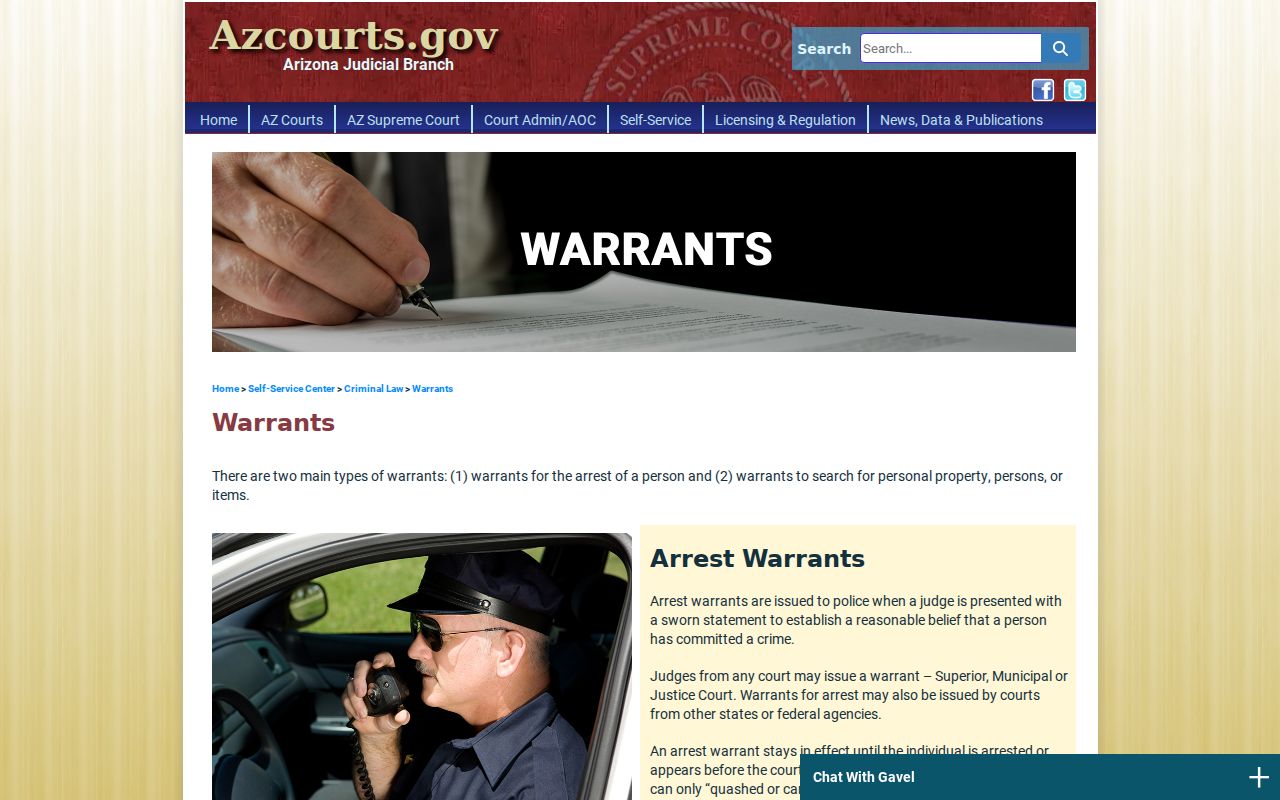
The state page sets the framework; the Gila County issuing court gives the operative answer. When a court sets an appearance, bond, recall, or release instruction, write down the clerk's name, the date, and the exact wording. A search result can lag behind a court update. And a vanished online entry is no substitute for an order, a receipt, or direct status confirmation. For a fuller account of who issues and who serves, the Gila County warrant records overview sorts out the court, clerk, Sheriff, police, and constable roles. That line keeps a records request or an old arrest entry from being mistaken for a current arrest warrant.